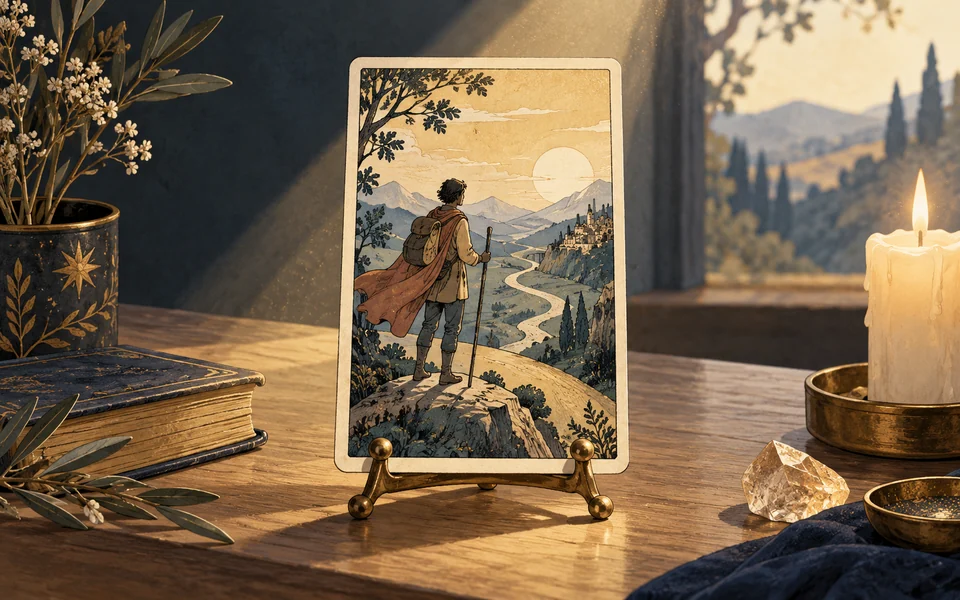
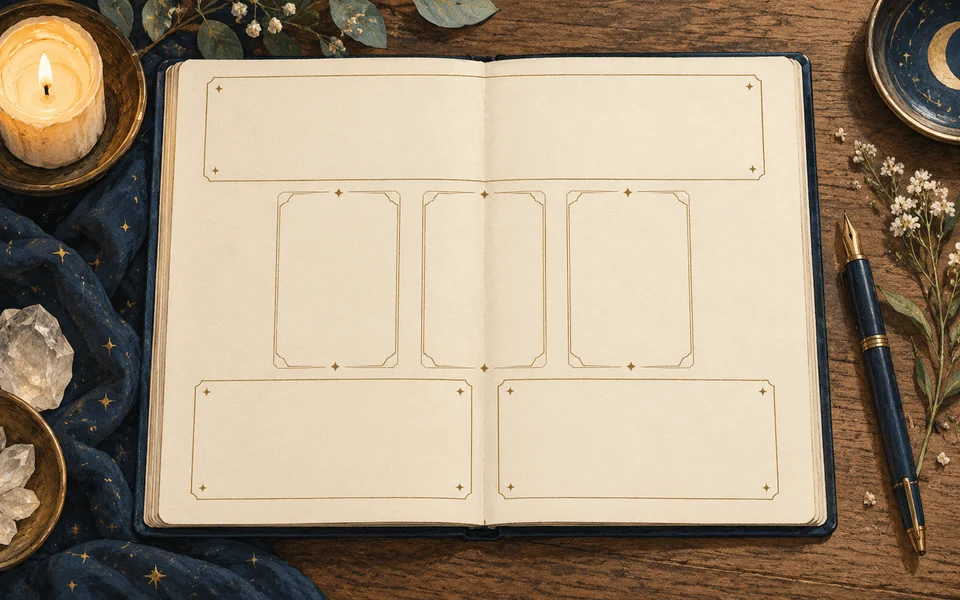
One card, one focus
A one-card spread gives a single image your full attention. It is useful for practising observation, testing a question, or revisiting an idea without the additional complexity of several positions. It does not provide a more certain answer because it contains fewer cards.
Choose a question about something you can consider or do. For a learning session, try “What can I notice about my approach to this task?” Write the question first. Decide whether you are using reversed cards before drawing rather than changing the rule after seeing a result.
Set up the exercise
Open tarot practice and select “One card.” Draw a card or manually record one from your physical deck. A digital draw selects from all 78 cards without assigning personal significance through your name, birth date, or question. Your question is not sent to a service to generate an interpretation.
Read the card’s name and orientation. The MystLume illustration reinterprets the traditional RWS scene. Compare what you actually see with the written symbol notes; the notes describe selected details, not every possible interpretation. Begin with one visible detail, then read the corresponding upright or reversed study note.
Work through an example
Imagine the question is “What could improve my next study session?” and the card is the Eight of Pentacles upright. The scene describes repeated work on a specific craft. One possible interpretation is to choose a narrow skill and practise it deliberately rather than trying to learn everything at once.
A concrete next step could be: “I will compare the imagery of two cards for ten minutes and write down one difference.” Another possible reading is that you already repeat an exercise but need feedback. The card alone does not tell you which interpretation fits. Use your actual circumstances to make that distinction.
Write before drawing again
Record an observation, your provisional interpretation, and one action. If the card feels unrelated, note that honestly. You can explore why the association was difficult without drawing repeatedly until you find a result you prefer.
For practice, consider one alternative interpretation or one reason the suggested meaning might not apply. This is especially useful when a familiar card makes you jump directly to a memorized phrase. Your task is to develop an explanation you can discuss, not to prove that every draw contains a hidden message.
Return to the note later
After trying the action, add what you noticed. Did the exercise help you focus? Was the interpretation too vague? Did another explanation fit better? Save the note in the reading journal if you want to keep it on this device, and export a backup before clearing browser data.
When one-card observations feel comfortable, move to the three-card guide. Keep the same habit of linking each interpretation to a position and an actual question.