Use a date that actually reaches 33
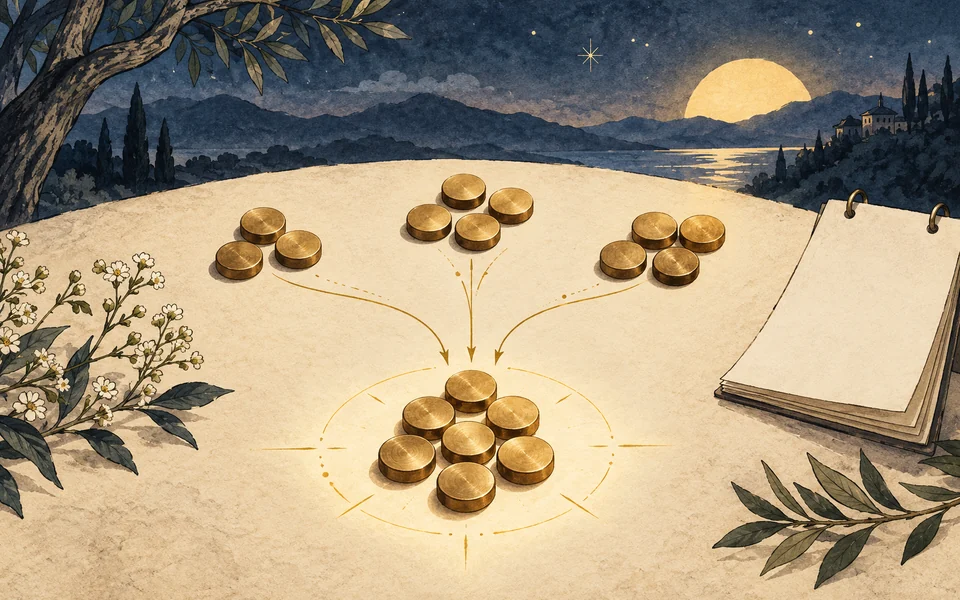
November 11, 2009 provides a clear component-method example. The month is 11 and remains 11. The day is also 11. The year reduces as 2 + 0 + 0 + 9 = 11, which is retained. Adding the components gives 11 + 11 + 11 = 33. The final value is kept, and its underlying root is 3 + 3 = 6.
That is why the result is written 33/6. It is not enough to notice several repeated digits in a date or to add selected numbers until 33 appears. The complete formula and each stopping point must remain the same from start to finish.
Check the alternative method
Using all-digits reduction, November 11, 2009 gives 1 + 1 + 1 + 1 + 2 + 0 + 0 + 9 = 15, then 1 + 5 = 6. In this example, the result is not 33. The life path calculator displays the comparison so the difference is visible rather than hidden behind two interpretation paragraphs.
If your own result differs, compare the date, the order of addition, and whether 11, 22, and 33 are kept at intermediate stages. Do not change one step simply to obtain a master number. The calculation-method guide explains how to compare conventions systematically.
Explore care without assigning a duty
Practitioner descriptions often connect 33 with teaching, service, or care. A grounded reflection asks how you help, what the other person actually needs, and which limits make that help sustainable. A symbolic association is not a requirement to put everyone else first.
Authored exercise: imagine offering to help a friend learn a skill. Write what you can demonstrate, how much time you can give, and how you will check whether the explanation was useful. Then write what belongs to the learner to practise independently. The exercise examines the quality of support rather than assuming that good intentions make every intervention helpful.
A master number is not a measure of worth
The same reflective questions can be useful to someone whose calculation does not produce 33. The number cannot prove that a person is unusually wise, responsible for others, or destined to teach. It also cannot explain away fatigue or a need for boundaries.
Keep the calculation and the interpretation in separate parts of your notes. The arithmetic can be checked exactly. The prompt needs to be assessed against experience, and you can discard it if it is not useful. Read the master-number overview for the stopping rules, then choose one ordinary situation in which care, clarity, or a practical limit would make a difference.